Showing posts with label International Relations. Show all posts

Wednesday, October 21, 2015

Tufts Intern Spotlight: Alicia Sanders-Zakre at the International Peace Bureau

Alicia Sanders-Zakre
Organization: International Peace Bureau (Geneva, Switzerland)

Year: Class of 2016 (graduating a year early)
Major: International Relations with a concentration in International Security
Duration: Summer
Compensation: Unpaid but funded through Tufts Career Center Internship Grant
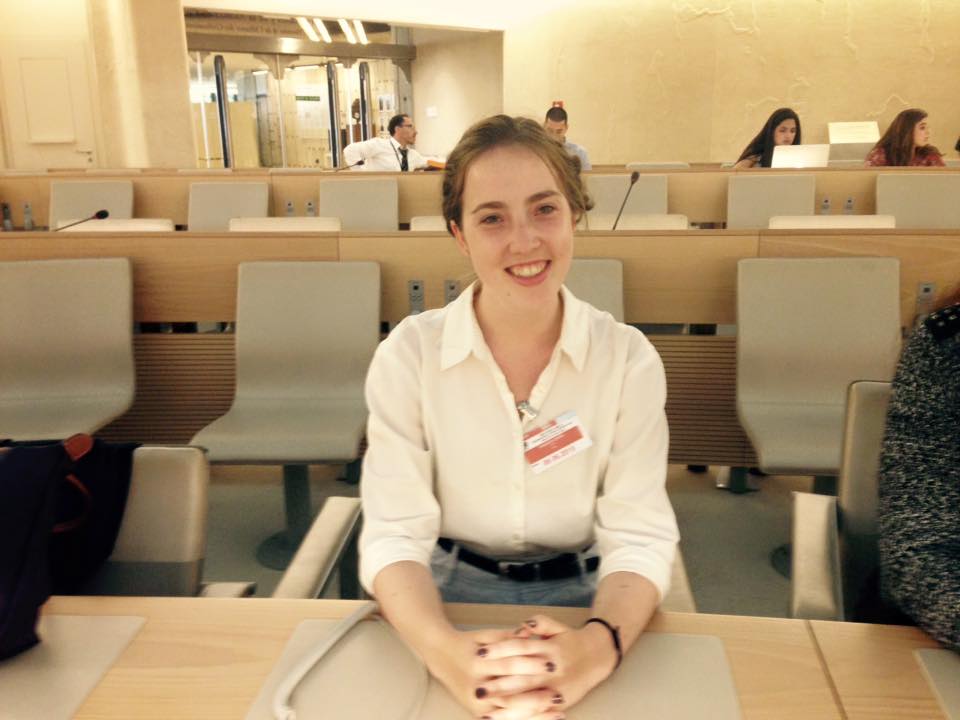

(photo credit: Alicia Sanders-Zakre)
This summer, Alicia chose an internship that fit her interests and helped her clearly visualize her future. With financial support from a Tufts Career Center Internship Grant (which just started to offer grants to internships abroad), Alicia spent her summer getting to know the international community in Geneva, Switzerland and experiencing what it's like working in the NGO (nongovernmental organization) environment and in disarmament affairs.


Sunrise in Geneva, Switzerland (photo credit: Alicia Sanders-Zakre)
Specialize your search when finding an internship. When it comes to applying for internships, Alicia believes in looking at internships that reflect your specific interests and connections, rather than applying to a slew of organizations that you don't relate well to.

Alicia found her internship by exploring the connections from her previous internship, American Friends Service Committee. After working on a project with AFSC that was endorsed by the International Peace Bureau, Alicia used her professional network to best position herself for her next opportunity. This way, when applying to the IPB, she had the advantage of highlighting work she did with AFSC in her cover letter.


Use each experience to bring you closer to your end goal (photo credit: Alicia Sanders-Zakre)
Independent work is a big part of interning. As an intern in charge of youth outreach, Alicia had many self-teaching moments. Not only did she have to independently research social media management techniques, but she also created a project for herself, the IPB online youth forum, after finding that she needed more work to do.

Organizations can sometimes have difficulty finding and assigning interns work - especially during the chaos of the workday. If your supervisor is often absent or busy, it's important to seek out advice from others and do some research yourself. A model intern, Alicia refused to be idle. She used her previous contacts at AFSC as well as the Career Center to ask questions and brainstorm new project ideas. Additionally, because of the more intimate environment of the IPB, it was easy for her to pitch her own projects. So even if you don't feel like you're getting much attention at your internship, you may have more power than you think. Like Alicia, if you find yourself twiddling your thumbs, don't get
 comfortable ...


Gruyères, Switzerland (photo credit: Alicia Sanders-Zakre)
Talk to people who are living the dream. By that, I mean, your dream profession. We see this with alum as well - people love to share their experiences and advice about how they got to where they are today. During her time at the IPB, Alicia spoke to multiple members of the United Nations and other NGOs. Through their experiences and advice, Alicia learned more about the steps she would have to take to pursue a career in disarmament affairs.

An intern's job is to learn. Take any opportunity to learn from those who work in the field. It can open your eyes to new opportunities in your desired field, or it can show you that this may not be the best path for you.


United Nations Institute for Disarmament Research (UNIDIR) panel on cybersecurity 
(photo credit: Alicia Sanders-Zakre)
Study abroad always brings a new perspective. As 40% of Geneva's residents are not native Swiss people, the city is a very diverse and international community. Even though Alicia initially felt nervous about connecting with other interns in her short-term residence, she eventually meshed with the interns from multiple offices and around the world. It was here where she got to speak to other students about their experiences and learn more about the top graduate programs in the UK, Norway, Sweden and Switzerland.

Like any study abroad opportunity, Alicia was introduced to an international population and learned more about the opportunities that exist beyond the US. If working abroad is something you're thinking about, it's definitely worth exploring the organization and internship opportunities there! A major takeaway from Alicia's internship was the interactions she had with the people she lived with and the things she learned from them. All in all, the abroad internship experience offers amazing learning experiences in and out of the office.


The abroad internship experience can be sweeter than this giant wall of chocolate
(photo credit: Alicia Sanders-Zakre)
If you would like to learn more about Alicia's experience or the experiences from our many other interns who also received Tufts Career Center Internship Grants, check out the Tufts Internship Profile (TIP) Book for detailed profiles!

Thanks for reading!


Nina Joung

Class of 2018

Friday, November 1, 2013

Tufts' Diplomat In Residence on Careers in the Foreign Service

My introduction to the Foreign Service
When I was a sophomore, I went to the Parents Weekend networking event and met a Foreign Service Officer. I asked him to tell me about what an average day was like. He said that there was no average day – that’s one of the best parts of being a Foreign Service Officer. I asked for examples, and he said that when he was working in Africa, he would typically get all the local newspapers, read through them to see what was happening and what issues merited investigation, and then go out and talk to people – from high officials to locals on the street – to compile a report on what was going on in the area. When he was posted in Afghanistan, he worked on shutting down the drug trade there. At first, their strategy was to barter with the village leaders: if you stop the drug trade in your area, we will improve your village with development projects (like roads and schools). This backfired because although it stopped some people, a scarcer supply made the drug trade even more lucrative and encouraged new people to join. I didn’t know anything about the Foreign Service before this, but hearing his stories inspired me to make it my new career goal. I later came to realize I was more interested in the idea of it than the actual content, so I’ve switched tacks, but I’d still like to pursue it later in life.

---

In September, I went to a presentation on careers in the State Department given by the State Department’s Diplomat in Residence for New England, Evyenia Sidereas, who is based here at Tufts. Since so many Tufts students are interested in international work, I thought it might be useful to recap some of the major take-aways about careers in the Civil or Foreign Service.

Before getting into all this, it's worth noting that you can only apply for internships or employment with the State Department if you're a US citizen. Also, if you're already set on aiming for the State Department/Foreign Service, check the bottom of the post for the contact info of Fletcher people willing to help you.


Did you know you don’t have to be a political science major to join the Foreign Service?
Few people realize that you can join the Foreign Service without a background in political science. In light of the emerging economic and security challenges facing the United States, the State Department needs officers with all kinds of backgrounds, including science, management, and economics. The State Department is also looking for technical experts to support U.S. diplomatic missions overseas as Foreign Service Specialists. There are 22 specialty tracks including careers in security, construction, IT, medicine, and administration (HR, logistics, finance, etc.). Evyenia said she’d like to see more economics majors with a business/finance background applying. The application process for Foreign Service Specialists is different from the one for Foreign Service Officers. It's based on resumes and subject expertise, as opposed to the Foreign Service Officer exam and Oral Assessment, which tests things like group work and written case management because they’re looking for traits than can be applied anywhere (such as being articulate and good at working with people).

Life in the Foreign Service:
The Foreign Service Officers represent the people of the United States overseas, and act as the Secretary of State’s foot soldiers, handling matters of foreign policy in embassies all over the world (more on what they're looking for in an FSO). There are about 14,000 Foreign Service Officers and Specialists at more than 270 posts in 190 countries. Most of your career as an FSO is spent overseas, rotating to a new post every few years (the length of your posting will vary depending on where you are in your career). Your first couple of tours are directed by the State Department, and you'll likely be doing consular work, which means handling visa issuance for host country nationals and taking care of American Citizen Services. As you become more established and build a reputation for good work, you’ll have more influence over where you’re assigned. What you do on a day-to-day basis depends entirely on your track, your position, and your post.

Key features of FSO life:
  • Public service
  • Overseas lifestyle
  • Challenging work with people
  • Lifelong learning
  • Constant variety and change
  • Learning foreign languages
But there are reasons why the Foreign Service isn’t a good fit for everyone:
It’s hard to keep up relationships when you move every few years, and it can make family life difficult since your kids and spouse will be uprooted so frequently. You have to go wherever you’re needed, and it may not be an enjoyable place to live. Every FSO is expected to take on some hardship posts - posts in places with living conditions bad enough to merit extra pay. Difficult conditions could include pollution, isolation, a harsh climate, health risks, scarcity of goods on the local market, crime, and other problems. Evyenia cited Astana, Kazakhstan as an example of a fascinating but challenging place to live, where the winters are -50 degrees and the summers are 120. As an example of health risks, she said that in the course of her career she has caught both dengue fever and giardia. Furthermore, a lot of posts are in areas with high rates of violence and crime, and a significant number of posts are designated as unaccompanied, meaning that it's dangerous or unpredictable enough that you can’t bring your family with you. This post from the Associates of the American Foreign Service Worldwide gives more detail on what life is like at a hardship post, both the good (such as a close-knit community) and the bad. Being an FSO is definitely an adventure, and I don’t mean that in a glamorous way. Here’s a short questionnaire to help you figure out if you’d be a good match for the FSO lifestyle.

If that doesn’t sound like your cup of tea:
If you prefer a more stable, predictable job, or if you prefer to specialize and work in one field all the time, you can join the State Department as part of the Civil Service. CS and FS perform similar functions and there’s a mix in every bureau at State Department headquarters in DC, but they have very different selection processes and career patterns. Most CS employees are based in DC and they don’t move around, so they bring long-term stability to particular issues. Instead of joining a general corps and then being assigned somewhere, you apply to specific CS positions through the USA Jobs website.

FSO Career Trajectory:
As for people who want to be generalists, there are five tracks: Consular Affairs, Economic Affairs, Management Affairs, Political Affairs, and Public Diplomacy. Everyone starts with consular work and takes on heavier responsibilities as they get promoted. You have to decide on a track before the test, and Evyenia notes that you should have a good reason you’re passionate about this field - not just “I love foreign affairs.”

Evyenia said to speak to your specific experience instead of saying what you think they want to hear. People come to the Foreign Service from all kinds of backgrounds - Evyenia mentioned one of the people accepted in her FSO class was a yoga teacher, and underscored that many FSOs come to this career with some life and professional experience. The median age of entry tends to be early 30's.


State Department programs open to you right now as a student:

Tufts sent 20 students to the State Department last summer as interns, one of the largest cohorts of any college in the US.

Internships
  • State Dept unpaid internships
    • In DC and Abroad
    • Summer, fall, and spring
    • Summers are a good time to intern because it’s a transition time for the State Dept. as people rotate positions so you might end up doing serious work filling in for someone in a high position who isn’t there yet
    • Fall deadline Nov. 1
    • Tufts has grants for unpaid internships in the public service sector
  • Pathways Program - paid, Civil Service
    • 3 types of Pathways appointments open to undergrads: internship, internship trainee, summer clerical
    • The Pathways Program has two other paid civil service programs for recent grads and advanced degree candidates

Fellowships - For more information about applying to these fellowships, see Anne Moore in the Office of Undergraduate Education.

  • Presidential Management Fellowship
    • Managed by the Office of Personnel Management, but the State Department hires many PMFs in a normal year
    • Brings you into civil service at a high rank
    • You can’t automatically transition to the FS but it gives you experience and makes you much more competitive
  • Thomas R. Pickering Foreign Affairs Fellowship Program - grad and undergrad
    • Three current Fletcher students have this fellowship
    • Apply during your junior year (deadline January 24) or before you start grad school (it will pay for your education)
    • Internship the first summer in at headquarters in Washington and an embassy overseas
  • Charles B. Rangel Fellowship Program - grad and undergrad
    • 3 Fletcher students have this fellowship
    • The Summer Enrichment Program for undergrads includes two courses, a seminar, visits to relevant institutions, and introductions to “a wide range of government and non-government professionals who work on global issues”
    • Applications open October 14th and close on February 10th
  • Boren Fellowship - grad students only
    • National Security issues and critical needs languages
  • Critical Languages Scholarship Program
    • The State Department sponsors fully funded intensive summer language institutes for 13 critical needs languages
For further information
Here’s a short questionnaire to figure out which program is right for you. Go to the State Department’s page on student opportunities to sign up for email updates on any of these programs. It will also tell you whether each program is still open for applications. For more information on the Foreign Service, you can visit the official Foreign Service Officer web page, and the Tufts International Relations Department also has a lot of resources for people interested in the Foreign Service. Tisch and Ginn have a number of relevant books, including a study guide for the FSO exam. In particular, I recommend Inside a US Embassy: Diplomacy at Work - I asked Tisch to buy it for their collection after reading rave reviews of this book on a LinkedIn group called Careers in Diplomacy. Like any LinkedIn group, a fair number of the "discussions" are people spamming links to their own work/organization, but it's a group worth keeping an eye on because there are some active threads with great advice. 

People to talk to at Tufts:
Even if you’ve already researched a career in foreign policy online, you might not be aware of the resources we have here at Tufts. Evyenia Sidereas, our Diplomat in Residence, is an active-duty political officer in the Foreign Service. She’s funny and approachable, so don’t be shy! Contact her at DIRNewEngland@state.gov. Evyenia introduced two Fletcher students, Paula Armstrong (Paula.M.Armstrong@gmail.com) and Ross Weistroffer (Ross.Weistroffer@tufts.edu) who have interned at the State Department and are willing to help students with internship applications.

Thursday, September 12, 2013

Hello from one of your new Student Ambassadors!

The Tufts Career Center is excited to welcome two students to the Career Services Ambassadors team. In addition to writing articles for this blog, our Ambassadors will also be helping to create content for and manage our social media outlets. Read their posts, and stay up to date on the latest Career Center happenings by following @TuftsCareer and liking us on Facebook! And now, a welcome back posts from one of our new Ambassadors, Morgan Kee.

Hi Tufts!

I'm Morgan, and I'll be one of the two Student Ambassadors keeping you connected to the Career Center through Facebook, Twitter, and this blog. I'll be recapping career-related events on campus, profiling notable students and alumni, and blogging about miscellaneous other career-related news and tips.

Here’s little about me, so you understand where I'm coming from: like a lot of Tufts students, I started out as an International Relations major. Sophomore year I decided to double major in IR and Sociology, but at this point I'm solely a Soc major. Dropping IR was a tough decision, especially since I'm only 3 credits away from finishing the major, but I felt that sociology and my newly added Communications and Media Studies minor would be more useful for me after college.

Earlier in my time at Tufts, I was really worried about finding a job considering that my liberal arts major seemingly came with no specific skill set, just vague, impossible-to-prove abilities like "analysis" and "critical thinking." But after four internships, I’m pretty sure I've sorted it out. After graduation, I’m hoping to apply the skills and knowledge I've learned from sociology and CMS towards a career in marketing. I've interned at two nonprofits (when I was still interested in nonprofit work as part of IR) and this past summer I worked at a small marketing agency. My work in the Career Center will be my fourth marketing internship.

I'm glad I can help spread the word about all the great stuff coming from the Career Center, because I think many students simply aren't aware of the resources available to them. And I'm excited to investigate and report for the blog on all kinds of things. Let me know if you have any questions or ideas for blog posts - this blog is for you!

You can email me or tweet @morgan_kee, where I post a lot of articles about social media, branding, technology, and startups.